UserVoice AI Reports
From Feedback Storage to Strategic Intelligence
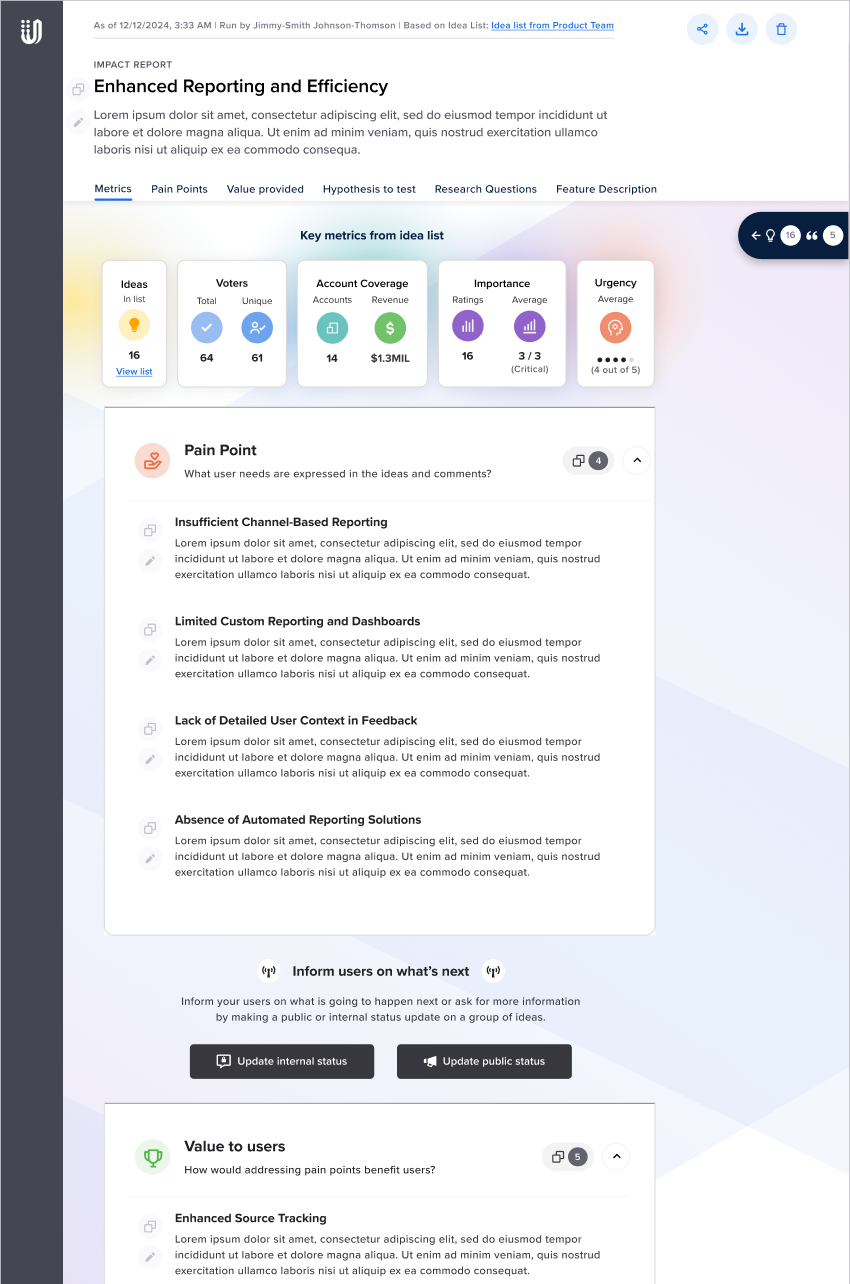
After six years at UserVoice, I’ve seen firsthand the challenge Product Managers face when trying to make sense of a high volume of feedback. A recurring theme in our research was that value was present in the data, but tapping into it required external tools and hours of manual labor.
PMs were drowning in a black hole of feedback—hundreds of ideas, comments, and votes—but lacked the connective tissue to turn that noise into a boardroom-ready strategy.
I led the design of the Impact Report, an experience that synthesizes raw feedback into a strategic brief. My goal was to move UserVoice from a storage tool to an intelligence engine that didn't just tell you what people were saying, but why it mattered and how much it was worth to the bottom line.
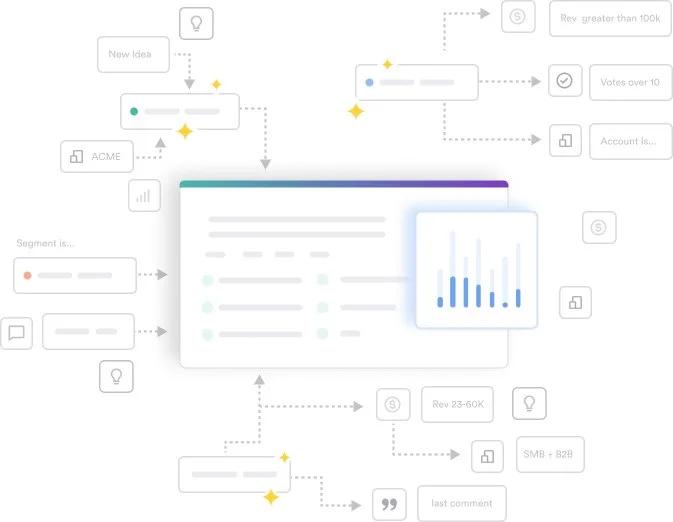
Problem : The High Cost of Manual Synthesis
In our internal discovery, we identified that manually auditing a single product theme was a half-day task. Because the effort was so high—requiring CSV exports and manual cross-referencing—deep research was often skipped in favor of gut feelings.
This created a vacuum for Analysis Paralysis
and Confirmation Bias.
PMs would often enter the feedback grid with a pre-existing idea of what they wanted to build, subconsciously cherry-picking comments that supported their roadmap. We needed a solution that didn't just summarize feedback, but purposefully challenged the PM to think more critically about the business impact and the "hidden" pain points their users were facing.

Success Criteria: Defining the North Star
To support the launch of our new AI-first subscription tier,
I defined success through four core strategic pillars:
Reduce Anxiety Volume
Shifting the manual synthesis process from a half-day task
to a 60-second generation, making the discovery process 99% faster.
Establish Verified Trust
Ensuring that GPT-assisted summaries weren't a "black box" by anchoring them to hard UserVoice data points like revenue and account impact.
Stakeholder Alignment
Providing a liquid asset (PDF/URL) that PMs could use to shorten the distance between a hypothesis and an executive yes.
De-risking over summarization
Measuring success not just by how many reports were run, but by how
often PMs engaged with the Research Prompts and Challenge Questions to refine their strategy.

Strategy: Designing for Strategic Friction
My strategy focused on three principles that guided every decision from the initial wireframes to the final components.
Establishing the "Verified Insight" Model
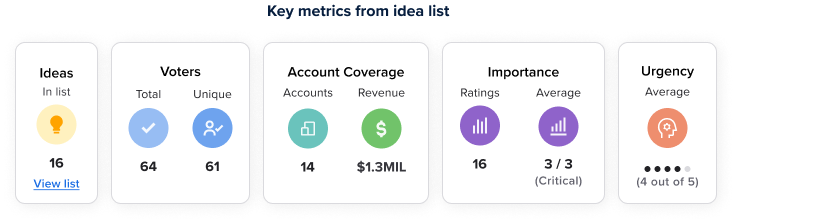
To solve the "Black Box" trust gap, the interface was built on a Quantitative Header system. By anchoring AI-generated summaries to hard metrics—revenue impact, vote counts, and urgency—the output shifted from a "suggestion" to a verifiable business case. This ensured PMs had the data necessary to defend their roadmap decisions to executive stakeholders.
Designing for Strategic Friction
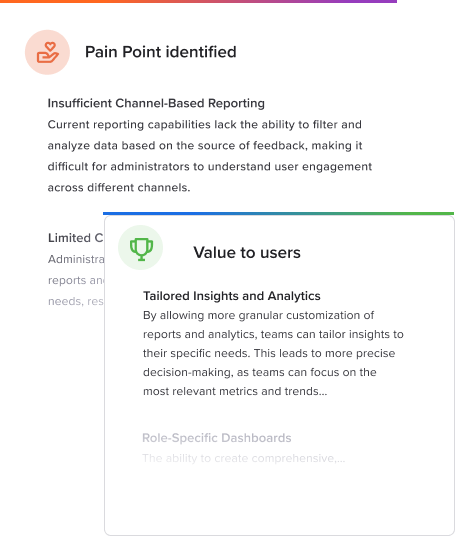
Working with a vision from our leadership to combat confirmation bias,
I translated the "Challenge the Hypothesis" concept into a functional tool. By purposefully surfacing "rabbit holes," unconsidered risks, and research prompts, the design introduces a layer of strategic friction. This moved the experience from passive summarization to a critical thinking partnership.
Building a Connected Discovery Ecosystem
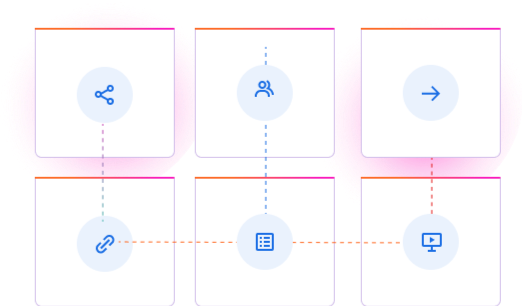
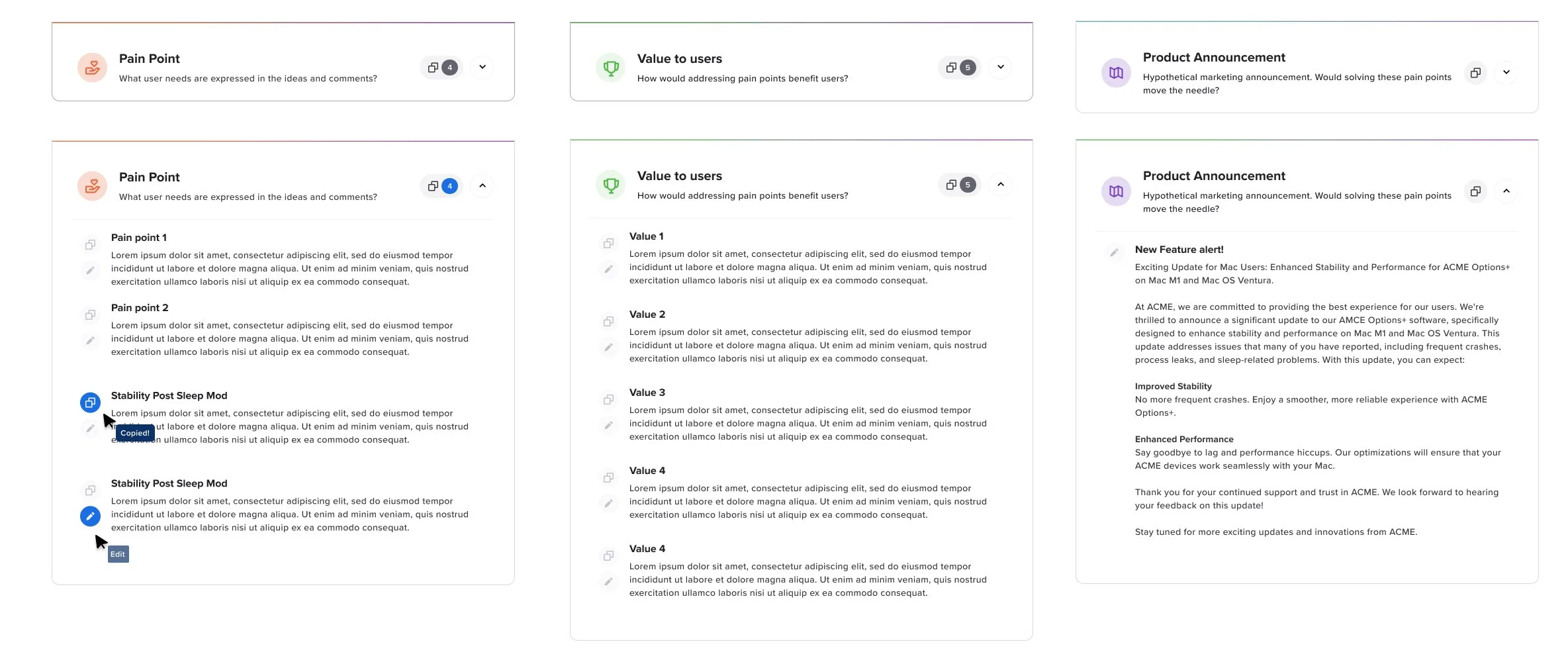
A primary goal was to ensure insights were never siloed. I architected the flow so that Impact Reports, Theme Reports, and Idea Lists lived within a single, linked ecosystem. To bridge the gap between discovery and action,
I prioritized Information Portability—implementing one-click section copying and high-fidelity exports to ensure the "Voice of the Customer" could easily move into JIRA, Slack, or executive slide decks.
Solution: An End-to-End Discovery Engine
The final design transformed the workflow into a seamless, two-step process that met the user exactly where they work
From Grid to Brief
To eliminate the friction of context-switching, the "Run Impact Report" trigger was integrated directly into the Quick Actions modal of the Idea Grid. This allows users to curate a specific list of ideas—up to 50 at a time—and generate a strategic brief without leaving the heart of their daily work. By meeting the user where their data already lives, the platform moves seamlessly from management to discovery.
Human-in-the-Loop interface
The design acknowledges that while AI provides a powerful first draft, the Product Manager provides the essential expertise. An Edit Mode was implemented to allow admins to tailor the language, refine bullet points, and add internal context before sharing. This ensures the final output remains a human-led strategy, supported—not replaced—by AI.
Designing for Business growth
Beyond the user experience, the solution had to serve as a primary revenue driver. A Gateway experience was created for non-paying users, utilizing "Free Previews" and contextual "Add-on" badges. This creates a natural upsell path, allowing prospects to experience the tangible value of the AI tier before encountering a paywall.


Impact: Evolving Product Strategy
The release of Impact Reports transformed feedback research from a time-intensive project into a sustainable daily habit. By eliminating the friction of manual data analysis, the platform now empowers Product Managers to lead with strategic maturity, replacing anecdotal evidence with boardroom-ready briefs.
This shift not only increased stakeholder confidence during prioritization but also served as a primary revenue driver for the new AI subscription tier—ultimately evolving UserVoice from a feedback collector into a strategic intelligence partner.
Before
4 hours of manual data synthesis per report.
High risk of Confirmation Bias in roadmap planning.
AI features felt like "Black Box" experiments.
No clear monetization strategy for AI utility.
After
Under 60 seconds to generate a strategic brief.
Automated "Devil’s Advocate" prompts to de-risk decisions.
Metric UI that executives trust.
Successfully launched as the core driver for the
AI Package subscription tier.